Authority and transmission
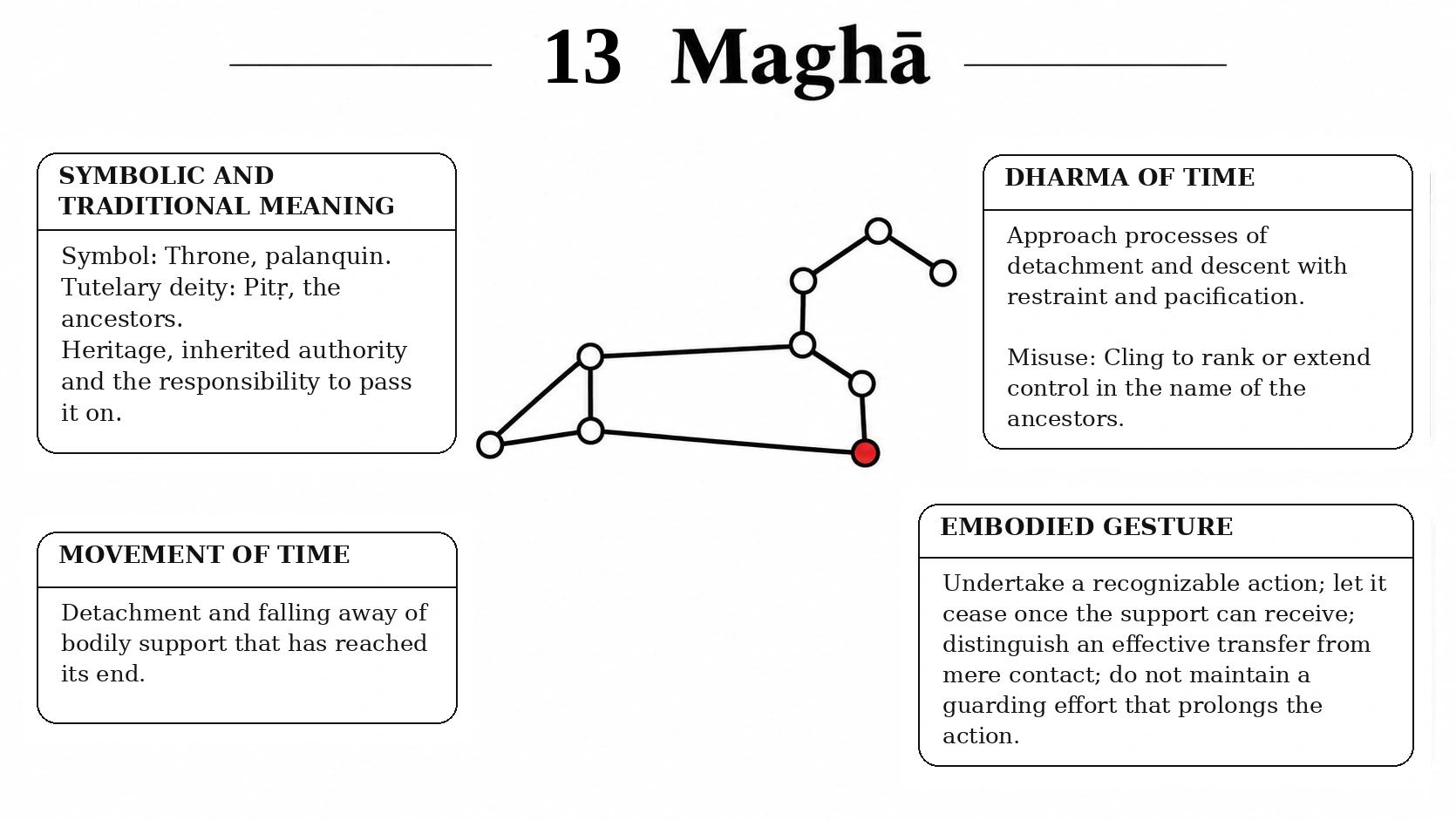
The Sun in Libra until the 16th places the will to lead before the need to work with others. Meanwhile, Jupiter and Ketu, very close in Leo and Maghā, question the trust placed in guides, doctrines and inherited traditions. Detachment can deepen discernment; it can also harden into certainty or rejection of all authority. The question concerns not only who leads, but what makes a direction legitimate and capable of being passed on.
Relationships and agreements
Venus returns to Virgo on the 5th, its sign of debilitation, without leaving Citrā. Attention to detail and adjustment can help make an agreement workable; taken too far, it feeds dissatisfaction and prevents recognition of what is already sufficiently right. The direct station on the 14th sets relationships moving again, but Venus remains in Virgo until the 22nd. Its return to Libra, its own sign, then gives conciliation and reciprocity more favourable support.
Action and conviction
Mars leaves Cancer for Leo on the 12th. Action can become more direct, less defensive and more visible. Its meeting with Jupiter and Ketu in Maghā nevertheless brings courage face to face with proportion: acting in service of a direction is not the same as imposing a conviction. On the 16th, Mars and Jupiter are very close in Maghā. This closeness strengthens engagement, with scope for generous initiative as well as overconfidence.
Endurance and collective momentum
Retrograde Saturn in Pisces and Uttara Bhādrapadā maintains a demand for patience, responsibility and constancy. Rāhu in Aquarius and Dhaniṣṭhā intensifies the search for visibility, gathering and group momentum. The Leo–Aquarius axis therefore brings the legitimacy of the person carrying responsibility into tension with collective participation. The Moon makes these questions more noticeable on certain dates.
1Physical body
Chest, heart and back form the month’s background, alongside lower abdomen, lower back and urinary region. November’s passages gradually specify abdominal and pelvic areas and bodily supports.
2Energy body
An Anāhata–Maṇipūra axis, with Svādhiṣṭhāna and Mūlādhāra as lasting counterpoints.
3Mind and inner life
A background of fixation and withdrawal, renewed momentum, then a possibility of clarification to sustain.
The month’s thresholds
1–11 November
Mercury’s return to Svātī on the 3rd supports a reassessment of how we understand, formulate and coordinate. Existing reference points may dissolve before a more appropriate formulation appears. The New Moon of the 8th–9th, in Viśākhā, opens a cycle around an intention whose effects are not yet fully visible. At sunrise on the 9th, the Sun and Moon are about 0°07 apart.
12–19 November
Mars entering Leo–Maghā on the 12th, followed by Mercury’s direct station on the 13th and Venus’s on the 14th, makes resumption more possible without making it uniform. The Sun enters Scorpio on the 16th: self-assertion focuses more strongly on what needs to be deepened or transformed. Its entry into Anurādhā on the 19th then shifts the emphasis towards commitments and relationships that make endurance possible. The Moon’s passage through Dhaniṣṭhā on the 17th brings collective participation to the foreground.
20–30 November
The Moon enters Saturn’s field on the 20th: stability and its conditions call for examination. Venus returns to Libra on the 22nd; the Full Moon on the 24th makes the cycle’s effects more visible; Mercury returns to Viśākhā on the 25th. Agreement can then support more directed progress. On the 30th, the Moon reactivates Maghā near Jupiter and Ketu: maturation, detachment and engagement remain distinct, even when they occupy the same field.
The month’s thresholds| Configuration | Pāda and dynamic |
|---|
| Venus: Citrā 3 at sunrise on the 5th; Citrā 2 from the 6th. Return to Libra on the 22nd. | Citrā 3 corresponds to Libra navāṃśa; Citrā 2 to Virgo navāṃśa. Venus moves from agreement supported by its own sign towards more demanding refinement. The station on the 14th does not change this sublevel; the return on the 22nd restores pāda 3. |
|---|
| Mercury: direct station on the 13th in Svātī 2, at 10°47′55″ Libra. | Svātī 2, Capricorn navāṃśa: structured reference points and a patient resumption of communication. |
|---|
| Sun: Viśākhā 1 on the 9th; Viśākhā 4 after entering Scorpio on the 16th. | Viśākhā 1, Aries navāṃśa, highlights the initial impulse; Viśākhā 4, Cancer navāṃśa, highlights receptivity and the conditions of support. The search for agreement in Libra becomes deeper involvement in Scorpio after the 16th. |
|---|
| At sunrise on the 17th: Moon in Dhaniṣṭhā 2, in Capricorn; Rāhu in Dhaniṣṭhā 3, in Aquarius. | Moon: kneecaps. Rāhu: ankles and calves. |
|---|
| 20 November · Uttara Bhādrapadā | Moon in pāda 1; Saturn in pāda 4. |
|---|
The physical body throughout the month
The month’s background brings the chest, heart and back into resonance, with a significant presence of the lower abdomen, lower back and urinary region. Mid-month, the gathering in Maghā reinforces the thoracic and dorsal axis; the Sun’s passage into Scorpio and then Anurādhā further specifies the abdominal and pelvic region. Calves and feet remain another background reference through Saturn in Uttara Bhādrapadā.
The physical body throughout the month| Period | Body locations | Doṣa |
|---|
| 1–5 November | Āśleṣā: thorax, diaphragm and digestive region. Maghā: heart and back. Svātī and Citrā in Libra: chest, neck, lower back and lower abdomen. | Kapha forms the background through Āśleṣā, Maghā and Svātī. Pitta provides the counterpoint through Citrā. |
|---|
| 6–11 November | Citrā in Virgo specifies the neck and lower abdomen. Viśākhā in Libra combines chest, lower abdomen, kidneys and bladder region. The Moon crosses these fields on the 7th–9th. | Kapha remains present through Viśākhā and Svātī; Pitta through Citrā. Vāta appears briefly through Jyeṣṭhā on the 11th. |
|---|
| 12–19 November | Maghā reinforces heart, back and the dorsal axis. From the 16th, Viśākhā in Scorpio specifies pelvis and genital region. On the 17th, Dhaniṣṭhā distinguishes lunar kneecaps from Rāhu’s ankles and calves. | Kapha remains Maghā’s terrain. Lunar passages through Jyeṣṭhā–Mūla, then Śatabhiṣa–Pūrva Bhādrapadā, introduce Vāta; Dhaniṣṭhā belongs to Pitta. |
|---|
| 20–30 November | Anurādhā: abdomen, pelvis and pelvic floor. On the 20th, Uttara Bhādrapadā highlights calves and feet. The Moon brings head, throat and upper body back into focus from the 22nd–28th, then heart and back on the 30th. | Pitta becomes more prominent through the Sun in Anurādhā, against the Kapha background of Maghā and Svātī/Viśākhā. Returns of Vāta are brief, particularly on the 22nd and 27th–28th. |
|---|
Cohesion, intensity and mobility
Here Kapha qualifies cohesion, carrying support and the possible difficulty of letting a fixed support end. Pitta specifies the clarity and intensity of shaping, gathering or settling; its presence does not mean effort should increase. Vāta colours moments of mobility and redistribution without replacing the month’s background.
In the context of care, the issue can be read as continuity of an actual capacity when its supports change: pass on useful information, make arrangements workable and recognise who takes over. In the prāṇic register, it means letting support circulate without stiffening the back, contracting the centre or multiplying compensations.
The energy body and chakra
An Anāhata–Maṇipūra axis, with Svādhiṣṭhāna and Mūlādhāra as lasting counterpoints.
The energy background combines Anāhata, through Maghā and Citrā, with Maṇipūra, through Svātī, then Viśākhā and Anurādhā. The first field makes support and its shaping more perceptible; the second clarifies the relationship between will, direction and fruit.
The energy body and chakra| Chakra | Nakṣatra and presences during the month | Prāṇic dynamic |
|---|
| Anāhata | Maghā: Jupiter and Ketu throughout the month, then Mars from the 12th. Citrā: Venus. Āśleṣā: Mars until the 12th. | Let support find its handover; attune the form without hardening it. Continuity should not depend on someone who can no longer carry everything. |
|---|
| Maṇipūra | Svātī: Mercury from the 3rd–25th, Sun until the 6th. Viśākhā: Sun from the 6th–19th, then Mercury from the 25th. Anurādhā: Sun from the 19th. | Let the current vary, then give it a direction that remains fruitful. Momentum is measured by what it allows to mature, without unnecessarily densifying the centre. |
|---|
| Svādhiṣṭhāna | Dhaniṣṭhā: Rāhu throughout the month; lunar passage on the 17th. The Moon also crosses Pūrvāṣāḍhā, Uttarāṣāḍhā, Śravaṇa and Śatabhiṣa on the 14th–18th. | Distribute contributions among several supports and centres; accompany circulation without imposing a rhythm on the breath. |
|---|
| Mūlādhāra | Uttara Bhādrapadā: Saturn throughout the month; lunar passage on the 20th. Pūrva Bhādrapadā: Moon on the 19th. | Establish a base that carries continuity. Stability remains available to movement and is not confused with immobilisation. |
|---|
| Ajñā | Revatī: Moon at sunrise on the 21st. | Receive nourishment and integrate it. |
|---|
| Viśuddha | Aśvinī to Punarvasu: the Moon’s route on the 22nd–28th. | A passage of clarification, unfolding and reopening, before the Moon returns towards Anāhata on the 29th–30th. |
|---|
From handover to a more habitable direction
From the 1st–11th, changes of form between Citrā and Svātī make the agreement between availability, circulation and direction more perceptible. From the 12th–19th, Anāhata remains strongly engaged through Maghā while the solar intention becomes clearer in Maṇipūra. Dhaniṣṭhā’s distribution on the 17th counters the risk of concentration. On the 20th, Mūlādhāra recalls the condition of endurance; Mercury’s return to Viśākhā on the 25th then allows what can resume to be redirected.
The spiritual dimension
Maghā invites us to honour a transmission by letting an old place come to an end. Svātī relates will to grace rather than mastery over change. Viśākhā asks us to recognise fruit as it ripens without making the goal a future possession. Anurādhā internalises fulfilment; Dhaniṣṭhā includes the “we” in giving; Uttara Bhādrapadā establishes a presence that lets life continue.
Guṇa and the collective mind
A background of fixation and withdrawal, renewed momentum, then a possibility of clarification to sustain.
At the beginning of the month, tamas predominates: reference points withdraw or become rigid, while initiative and clarity in agreements remain obstructed. Rajas is not absent; it appears in the effort to repair, persuade or restart. The collective question is then to distinguish real maturation from agitation that merely protects old forms.
Guṇa and the collective mind| Structuring nakṣatra | Guṇa signature |
|---|
| Maghā | Tamas / Rajas / Rajas |
|---|
| Citrā | Tamas / Tamas / Tamas |
|---|
| Svātī | Tamas / Tamas / Sattva |
|---|
| Viśākhā | Tamas / Sattva / Rajas |
|---|
| Anurādhā | Tamas / Sattva / Tamas |
|---|
| Dhaniṣṭhā | Sattva / Tamas / Tamas |
|---|
| Uttara Bhādrapadā | Sattva / Sattva / Tamas |
|---|
| Revatī, lunar illumination on the 21st | Sattva / Sattva / Sattva |
|---|
1–11 November: tamas and the work of discernment
Citrā can accentuate confinement within a form to perfect; Svātī, uncertainty when old outlines no longer hold. Approaching the New Moon, withdrawal needs time. Sattva becomes possible when discernment recognises what is ending without treating that withdrawal as an absence of meaning or resources.
12–19 November: rajas mobilises against a background of tamas
Mars in Maghā and the direct stations make momentum more available. Yet resumption may maintain the same fixation in a more active form: wanting to persuade, restore one’s place or hasten the outcome. Dhaniṣṭhā on the 17th tests group momentum: gathering becomes more appropriate when it includes contributions instead of concentrating recognition.
20–30 November: support sattva
Uttara Bhādrapadā on the 20th, then Revatī on the 21st, illuminate stability and nourishment. Venus’s return to Libra on the 22nd and Mercury’s resumption in Viśākhā on the 25th can make agreement and intention clearer. Yet Maghā’s background remains present and returns to the foreground on the 30th: clarification is tested through detachment, proportion and the capacity to let other supports carry continuity.
On the spiritual path, tamas calls for recognition of inertia or closure, rajas for proportion in appropriating the fruit, and sattva for cultivation of an available presence.