Support
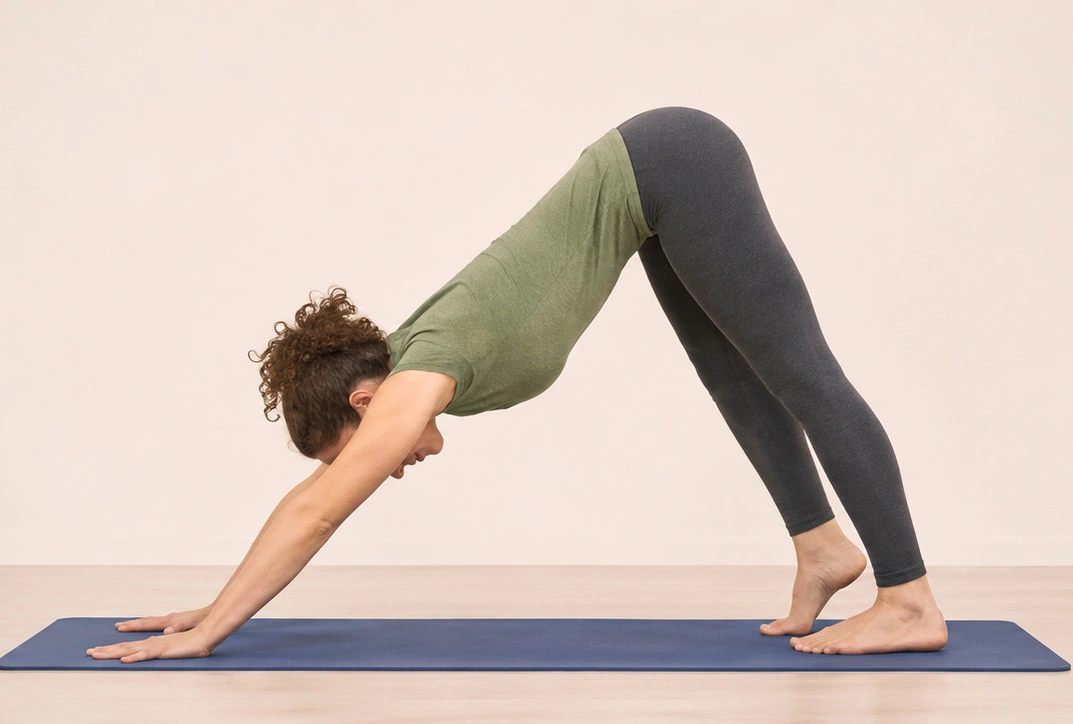
Choose the form to be practised before testing the heel. If an adapted Downward-Facing Dog already allows the right heel to touch the floor without straining the calf, ankle or back, prepare that form with the necessary supports. From hands and knees, tuck the toes and let the pelvis move gently back and up, keeping the palms weight-bearing. Keep the knees soft; the left heel need not be down in the same way as the right. Do not pull the right heel toward the mat to obtain the required shape. If initial contact of the right heel is not naturally accessible, choose a stable seated position now, with the pelvis supported and the feet on the floor. In either case, let breathing follow its ordinary rhythm; do not hold the breath. Recognize that the body has genuine support before moving. The right heel must not be forced to the floor to begin the practice.
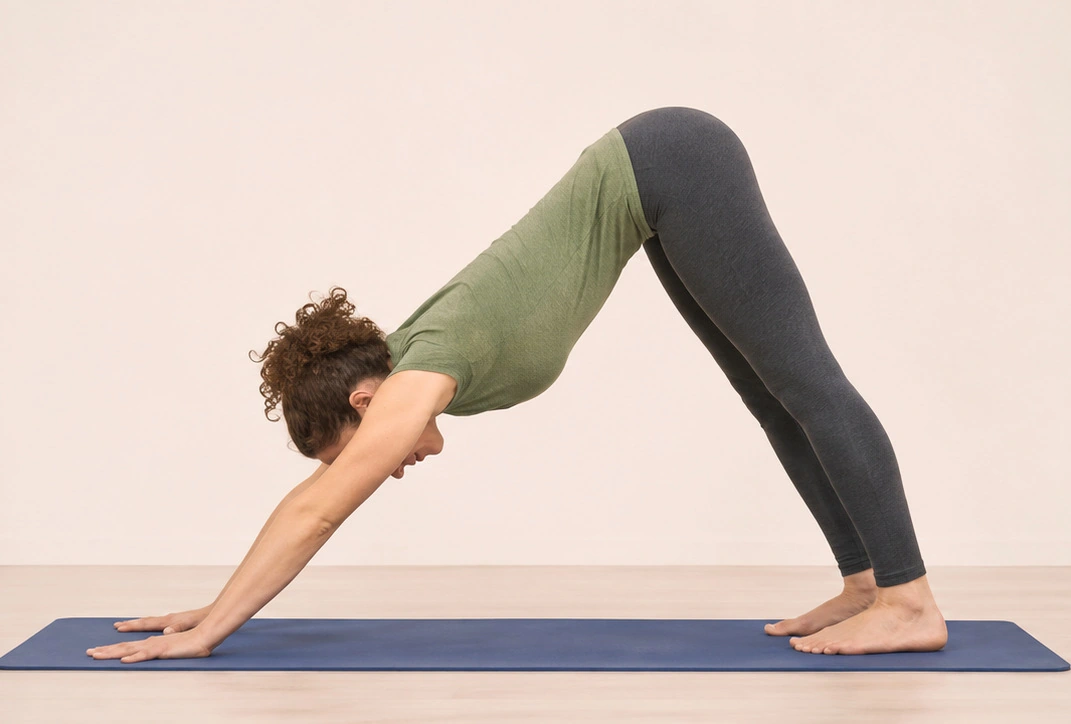
In the accessible Dog, recognize that the right heel and forefoot are already touching the mat. Feel the palms support the upper body while the feet and legs accompany the pelvis. The right-side contact exists; there is no need to press harder to make it more certain. Let a natural breath pass through shoulders, back and legs. If the seated alternative was chosen from the beginning, keep the pelvis fully supported, the left foot on the floor and the right heel resting. Only in this stable sitting position, if one hand is free and the neck comfortable, a short Nāḍīśodhana alternation may be offered: inhale gently through the left nostril, exhale through the right, inhale through the right and exhale through the left, without retention or prescribed timing. One cycle is enough. Then rest the hands. Do not leave Downward Dog to practise Nāḍīśodhana. The breath accompanies a contact already present rather than trying to reinforce it.
If the Dog already demands too much effort, lower the knees while keeping the palms available. Let the pelvis move into an accessible kneeling rest without forcing contact with the heels. Receive a natural breath as the work of the arms and legs diminishes. Only if that rest has genuinely made the task accessible again, and the right heel can still touch the mat naturally, return once to the same small Dog. If that contact is no longer available, do not try another setup. If the Dog was comfortable from the outset, simply keep its shape without imposing a descent and ascent. With the seated alternative, let the pelvis and feet retain their support; use the backrest if helpful. Preparation must not become repeated attempts to achieve an ideal contact. The chosen form is the one in which the small movement can be experienced without strain.
If the Dog remains accessible and the right heel rests naturally, keep the right forefoot in steady contact with the mat. On an easy exhalation, if one comes naturally, lift the right heel only very slightly. Do not rise high onto the ball of the foot. Let the calf work just enough to create that minimal separation. The palms remain weight-bearing; the left foot and right forefoot keep their supports. Do not rotate the pelvis or shift weight onto the hands to lift the heel higher. Let the breath renew freely even if the motion continues beyond the exhalation. If sitting was chosen, the same tiny heel lift may occur with the pelvis still supported and the right forefoot on the floor. There will be only one lift. If initial contact was left, the separation was minimal but real; otherwise do not assume a lift occurred. There is no need to prolong even a small lift. If no safe lift was achieved, do not perform steps 5–7 as though it had occurred: proceed to the return and rest described in steps 8 and 9, in the accessible form, and choose the corresponding alternative meditation.